Home Mission pics

Home Mission pics

Tuesday, 21 December 2010

"We've started on a journey with these most beautiful of people"

Grace Tucker, Pastoral Leader at Ruardean Hill Baptist Church in the Forest of Dean, followed our feature about work with people with Learning Disabilities with this lovely Christmas story:
 
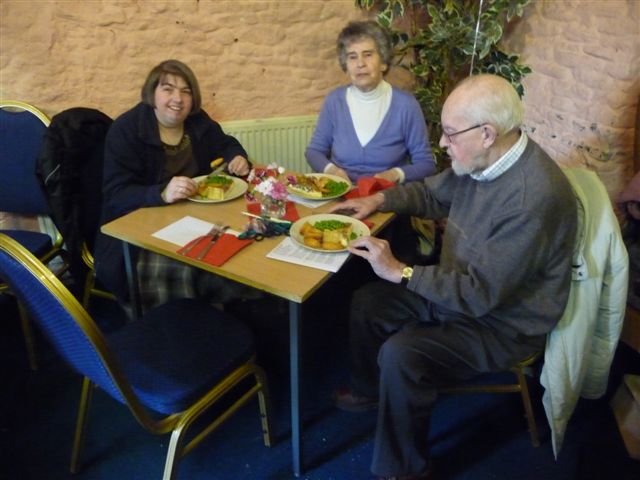
We are a small rural fellowship with just seven members but have a big heart to know and make known the love of Jesus in our community.  During this year we have developed relationship with two local residential disability homes.  One of the church members has been visiting the homes and conversation developed around the possibility of their coming to the chapel for a special Christmas celebration. 
 
     In September we started a JAM club for 9 – 13 year olds and so we asked  if they would like to help.  They would! Their task was to help simply tell the nativity story, dress up, help with the singing and hand round the mince pies afterwards – this they did admirably! 
Musical instruments were handed around, everyone was relaxed and joined in the fun. 
 
    Just before we served the mince pies we ran an impromptu nativity story that we had shared earlier in the week with our Toddler Group – guests were given  a sheep, a camel, baby Jesus, the three gifts etc., to bring to the front and place by the crib at the required time.  This time the story was interspersed with Mary had a baby, twinkle twinkle little star and bar bar black sheep.  There was much fun and laughter and everyone wanted their picture taken!!  
  
Some of the more able residents learnt that we were holding our Christingle service on Sunday and  a ‘make your own Christmas Wreath’ the following Thursday – they’ve asked if they can come back!
 
   I am sure we’ve started on a journey with these most beautiful of people – we are asking God that he will continue to use us, small as we are,  to touch their lives and the lives of their carers.   
 

Tuesday, 14 December 2010

Nativity

Some of you may be aware of the BBC mini series 'Nativity' which will be on TV next week. I'm reproducing here in full this 'review with a mission' by Peter Graystone of the Church Army and 'Fresh Expressions', taken from the Churches Together in England website:

I went to the press preview screening of the BBC/Red Planet series The Nativity at the end of October. The good news is that it is wonderful television. And it opens up an astonishing evangelistic opportunity for us.

My main message is that we can commend it to every church as something they can recommend with total confidence to their congregations and (even more importantly) those with whom they are in touch beyond their churches.

It's in four episodes that will be broadcast on BBC1 in middle of the evening in the week leading up to Christmas Eve. And it is going to do more to promote Christian faith in this country than all the sermons of the year put together. It is that good!

Nativity 3

Churches need to be geared up to the fact that their major opportunity to present the gospel this year may not be at a carol service held on Sunday 19 December (which will be before the series has been broadcast) but on Christmas Eve and Christmas Day (when I anticipate that people who have watched the series may want to come to church looking to find out what it all means for them).

Basically the serial tells the stories as they have been handed down to us with straightforward acceptance of them as true. It fills out the back-story with motivations and emotions in order to make it entirely credible. Admittedly, it does incorporate two thousand years of tradition that has gathered around the story (for example, there is a donkey, Mary ends up in blue, all the characters end up squashed in a stable, and so on). But the fact that it declares that this baby is going to save humankind from its sins is so overpowering that all the embellishments become part of the credibility, not distracting.

It is not just moving, it is funny (very), believable (totally), sexy (yes!), tense and profoundly full of the grace of God. And the awe of God too - the writer Tony Jordan has worked a miracle. Half way through each episode the camera pans back way out into the cosmos, and you hear deep groans, as if something tremendously significant is happening in both heaven and earth. And it ends with a declaration that because of this birth, the salvation of humankind is on its way. Then you hear the voice of the adult Jesus reciting the Beatitudes.

I started crying half way through the third episode (when Mary's father, who doesn't even exist in the Bible version, stands by his daughter even though she is in disgrace). And by the end of episode four (when ... actually, I don't want to spoil it) I was drowning. Fact! So was everyone.

At the preview they interviewed Tony Jordan (creator of Life on Mars and writer of Eastenders). He said: ‘I’ve always had a faith. I’m not a God-botherer … But I do believe that Jesus Christ was the Son of God. I do believe he came here to take away our sins. I absolutely believe that. But there’s loads of little bits around it that bug me. So what I’ve done with the story of the nativity is written a version that I can believe.

‘And I believe that the people who watch it who aren’t already sold, who would ridicule another version with square beards, [will find that] I’ve made it accessible. So they can watch it and see it’s truthful, and say, “You know what! That’s really cool. I never realised it could be like that. I thought it was all beyond me.” … Watch it, believe it, invest in it, and sob like a child.’

I did. You will.

Friday, 10 December 2010

Your Gifts for Mission

WEBA retained its position at the top of the Home Mission Giving charts in November, with gifts totalling £20,731. Our total for the year is now £227,500  that's £33.28 each, a higher rate per church member than any other regional association.
This is great news as the resources we have to spend in this region as a result are directly affected by local giving. Many of the stories in this blog, and many others like them, are made possible by Home Mission funding.
So- thank you, churches, large and small, your faith and generosity overwhelms those of us who collect these gifts month by month.
  • If you are responsible for passing on Home Mission cheques, please make sure your gifts reach us by Friday 17th December so that they can be included with this year's total. 
  • If your church receives, or has received a Home Mission grant, please tell us your story! You can comment below, or send your own blog post, ideally with pictures, to ruth.whiter@webassoc.org.uk


Friday, 26 November 2010

The Art Experiment at Totterdown


The Front Room Art Trail has been running each November in the Totterdown area of South Bristol for ten years. It's enormously popular; people open their homes and display work that is either their own or by the hundreds of artists who apply to take part each year. I used to love looking round these houses, enjoying the spirit of trust and community the event engendered, and wish that my church, Totterdown Baptist, could somehow be part of it. I think I thought that the church, with its focus on evangelism through words, wouldn't be interested, and that the Front Room committee, being rather arty, would look down on the church.

This changed very quickly when the trail decided to expand its borders and ask us to take part.. I don't get to look round many houses now, because for the last four years the church has hosted an exhibition of  between 15 and 20 artists each year. Every year I manage a waiting list of those trying to reserve a space. Every year the church serves teas, coffees, and lots of homemade cakes and chats to the wider community as they stream through on Saturday and Sunday. Front Room has become our front room, where the neighbours come in and have a chat. Some of them have become friends.Who knows how many of them see us very differently - or notice us at all - as a result.

Tuesday, 23 November 2010

Reaching Out with No Limits

This article appears in the Winter edition of WEBA News, our quarterly printed newsletter. Thanks to all those who spent time on the phone to me, enthusing about working and worshipping with people with learning disabilities - and to those I didn't even get round to speaking to. Please add comments about your own church's experiences!
Ruth
It’s Sunday morning in the Crown Inn in Minchinhampton. Rose, the landlady, serves regulars on one side of the bar, some of them watching a group from the local Baptist Church on the other side, who are just finishing a Bible Study. This group now head to the function room at the back of the pub, ‘the barn’, where another group of adults have been busy with a hands-on activity. Now everyone moves to separate tables for prayer. After this, there’ll be a cooked lunch, and Rose, who provides the room for free, will also do all the washing up, simply because she thinks that “it’s wonderful what you’re doing in there.”

This is Specially 4 U, a group run by Minchinhampton Baptist Church in Gloucestershire, and it is only one of many similar groups around WEBA. They are responding to the social and spiritual needs of one of the largest unreached people groups in our country—those with learning disabilities. The group leaders I have spoken to all agree on one thing— serving this particular group of people  brings benefits to a much wider circle, both within the church family and outside.

Specially 4 U began as part of a fresh expressions initiative at Minchinhampton Baptist Church, and it has continued at the pub, running alongside the usual Sunday morning service. John Barnard, who has always fought for his own daughter to be recognised as an ‘ordinary’ person, is one of the organisers. He explains that the Bible Study in the bar came about was included for those not involved with the activities.

“We’ve had people from church come along who are obviously in a bad place—people feel more comfortable here.”
Many participants come with carers, often from residential homes. “The carers used to sit and read newspapers”, says John. “Now they join in.”

While the Crown is a fantastic venue for these services, its size means the group’s outreach is restricted—they can’t go out and actively invite more people living in the community. John feels that they will need to move back to the church building eventually, and would like the church to make this a more integral part of what they do.

John admits there can be a tendency for churches to be more comfortable isolating these groups from the congregation— “people think something is going to happen they can’t cope with” - whereas actually those with ‘learning disabilities’ can help us overcome some of the inhibitions that limit our services. Group members at Specially for You often interact with the Bible story by contributing stories of their own. When the music group sings, others tend to come to the front and sing with them. After this, he says, “you know that ‘ordinary’ church will be less of a spiritual experience for you.”

Jacky Newman’s son Tim has Downs Syndrome, and when she wondered what to do about the fact that he just didn’t fit in to the youth group at Southwick Baptist Church, she realised that here was a vast group of unreached people. She has now been leading their No Limits group for about thirteen years. The group meets three times a month on a Tuesday— two of those are social evenings, and one is a time of worship and sharing. There are about 16 group members, six of whom are active church members, and several have been baptised.

Jacky, too, remarks on the spiritual benefits of worshipping and learning with those with learning disabilities— “they come up with things you’d never thought about” - and that this kind of mission reaches a wide circle of people outside of the church: “The group has attracted more people into the church, and for some people it gives them a role within the church—something they can do.”
Gordon Cloud, who runs the Build Club at Clarence Park Baptist Church in Weston-super-Mare, agrees with this:
“I think what we do with Build is probably the best outreach thing we do in the church. It’s the fringe people—carers, houses, families—they’re seeing that the church is a caring place to be.” This group has also been running for about 13 years, and has the same format of two social events and one Bible Class every month. The group puts on its own outreach events—a concert with cream teas, a Christmas party. They are a well integrated part of the church family and take part in services, running two or three songs and doing readings.

Gordon is convinced that many churches are missing this opportunity to serve Christ and their communities. While many people with learning disabilities enjoy church and see it as an accepting place, they could be catered for more specifically:
“I think there’s a place in every church for a group of this sort, the way you have a group for children. Churches cater a lot for children but they don’t always cater for people with disabilities.”


Getting Started

  • The Build Club at Clarence Park is named after the support organisation of that name—the Baptist Union Initiative with People with Learning Disabilities. They offer  conferences, a twice yearly newsletter, resources, and support and advice. We’ve enclosed a BUild flyer with this newsletter, or you can contact David Buckingham on 01782 618966  to find out about joining.
  • Causeway Prospects  is an ecumenical organisation dedicated to providing “advice, training and resource materials to equip churches for effective ministry and outreach among people dearly loved by God and often marginalised by society” Their website is www.prospects.org.uk or you can contact them on 0118 951 6978.
  • Several of the people who we interviewed for this article are more than happy to chat about what you might be able to do at your church:
  • · Gordon Cloud can be contacted by email at gordon.cloud@googlemail.com or on 01934 628312. He would be willing to undertake informal training with people from local churches.
  • · Sue Wright also worked with the Clarence Park Build Group and now serves on the Build Committee. “We need the churches to know there are people with a wealth of experience they can come to” she says. You can contact Sue at  davidsue@headland1.plus.com or on 01934 420719
 
  • · If you’re starting with very few group members and want to find more, it’s possible to get the group listed with Social Services. People with learning disabilities and their carers put together a care plan which includes ‘spiritual development’ - social services may be grateful for a group they can refer people to.

  • · If you’re in Bristol, and your church needs a cleaner, you could offer a local person with Learning Disabilities the dignity and satisfaction that comes with work. A Clean Sweep is a co-operative owned and run by people with Learning Disabilities, and supported by Mencap. Contact them on 0117 9653492,  or see the WEBA website opportunities page for more contact details.


Toddler Time for Dads


For a number of years Fishponds Baptist Church has run a very popular “Toddler Time” group on a Monday and Friday morning.    There are forty places available at each session, and there is usually a waiting list.

In March of this year, the Associate Minister, Darren Smith, and one of the leaders of the toddler group, attended a seminar at Baptist House in Didcot, when a number of issues relating to toddlers was discussed.   One of the speakers was from an organisation called “Who Let the Dads Out”.    It was subsequently agreed that the church would start up a group for the dads, and so “Toddler Time for Dads” commenced in September.  

  The group meets on a Saturday morning once a month, and the format is very similar to the week day groups, except that bacon butties are served, and newspapers are provided.   The idea behind this initiative is that it is men organising the group for dads (and granddads), so there are two men from the catering team in the kitchen providing the refreshments, and Darren welcomes dads at the door and reads the story.   A few church dads come along with their small children and help to host the morning.   The plan in future is to organise a craft table, and finish the session with a time of singing.

After three sessions there are 28 children on the register, which has been a great encouragement.   All the dads say how much they enjoy bringing their children along, as they find it hard to join in a regular toddler group where they are often in the minority.


“Toddler Time” has been a great outreach opportunity, and good links are being made with people in the community – there are now eight families coming along from the road adjacent to the church, and they have all welcomed the opportunity to get to know each other.


A Christmas carol service for toddlers and their parents is to be held in December in the church, and this will provide an opportunity for families to hear more about the real meaning of Christmas.    This event was held for the first time last year, when more than 100 people attended.

If anyone would like to know more about running a toddler group for dads, then please get in touch with Darren, who will be more than happy to share his newly discovered gifts with the smallest people in the church.


Contact details:
Rev Darren J Smith
Tel:  0117 9651491

Thursday, 18 November 2010

Small churches...changes in culture


If you’re old enough (?) you’ll no doubt have noticed the catalogue of changes in our UK culture during the past 30 or so years.   (Just think back to the ‘flares’ you wore in the 70’s!).   Mission-shaped Church (a report by the C of E’s Mission & Public Affairs Council, 2004) highlights various social, cultural and spiritual changes in the UK since the 1970’s.  More recently, the charity, Tearfund, produced some sobering statistics on Church attendance in the UK (2007), which showed that 60% of the population of the UK are now ‘closed’ to the idea of attending church.  In other words, they don’t intend coming to your church or mine - no matter how good the music, preaching, coffee or ‘fellowship’ is.

This poses a challenge for many of us – as often our main model of church is an ‘attractional’ one.  That is we try to attract people to our services on the basis of our ‘worship’ (usually meaning our musical style and the songs we sing and tend not to sing) and the programmes we offer (such as children’s and youth work).  When we operate in a purely ‘attractional’ way, we overlook the 60% who report that they are ‘closed’ to coming to church.  Not only this, but those churches who are ‘challenged’ in terms of personnel and finance find that they can’t ‘compete’ in the attractional marketplace.

Recently, we held the first of our WEBA Mobilising Small Churches events.  The Regional Team are inviting our churches with fewer than 40 members to reflect with us on how such cultural changes have made an impact upon our smaller churches and how we might wisely respond to this situation.  We have already asked the question, ‘Whose church is it, anyway?’  And as we make our way on this journey we’ll reflect upon and ask, ‘If those 60% of people won’t come to us – how can we ‘go!’ (remember that Jesus word!) to them?’  What might it look like to explore a different model of being church – one that is more incarnational (living among the people)?  How can we learn to do life alongside those people Jesus calls us to love (our ‘neighbours’)?  And what does it look like in 2010 to love our neighbours and to be ‘salt’ and ‘light’ where you live/work/socialise and where I live/work/socialise?  In Matthew 5 (The Message) Jesus says to his disciples, "Let me tell you why you are here. You're here to be salt-seasoning that brings out the God-flavours of this earth… You're here to be light, bringing out the God-colours in the world.”

What might that look like for our smaller churches as they move towards 2011?  And what might it look like for your church…and your life…and my life?
By the way…the invitation is still open for leaders of our smaller churches to join us on this important journey.

Alisdair Longwill, Regional Minister